


I’m in support of farming under nets where and when it makes sense.
And if you’ve ever watched a hailstorm erase a season’s crop in less than 15 minutes, you don’t need a long debate about whether protective structures are important or not.
Nets protect fruit. They protect margin. They protect confidence. They reduce certain risk factors.
But once you put a block under net, you have not only changed the crop environment.
You have changed the operating environment. Especially for AgTech.
That is the point of this post. Not to criticise netting. But to name the friction points that show up once technology meets netting infrastructure. Then to offer practical ways to design around them.
Because the farms that get the most value from nets are often the ones that adapt their tech stack early. Not the ones that try to run open-orchard workflows under a very different system.
Why nets win
Nets reduce downside risk. They stabilise outcomes.
In many orchards and vineyards, they can reduce sunburn. Reduce bird damage. Reduce hail exposure. Reduce wind stress and physical fruit marking. Improve uniformity and ensure there is still pack-out in messy seasons.
That matters.
Now for the part we usually learn after installation.
The core shift: under-net farming becomes an autonomy and access problem
Most agricultural automation assumes some version of open sky, open headlands, and open flight paths.
Not always explicitly. Sometimes it’s hidden inside the physics of sensors, the assumptions of models, or the practical realities of access.
Under net, the signal you are trying to capture is still there.
But the environment introduces a new kind of noise and a new kind of constraint.
Sometimes the cost of getting the same insight rises.
Sometimes only small tweaks are needed. Mostly a perspective shift, plus a few subtleties.
One question helps keep the team honest:
Are you measuring the trees? Or are you measuring the system that surrounds them?
Netting can become a barrier, physically and metaphorically, between reality and your instruments.
So let’s get specific. Ground-based autonomy and aerial autonomy are both affected. In different ways.
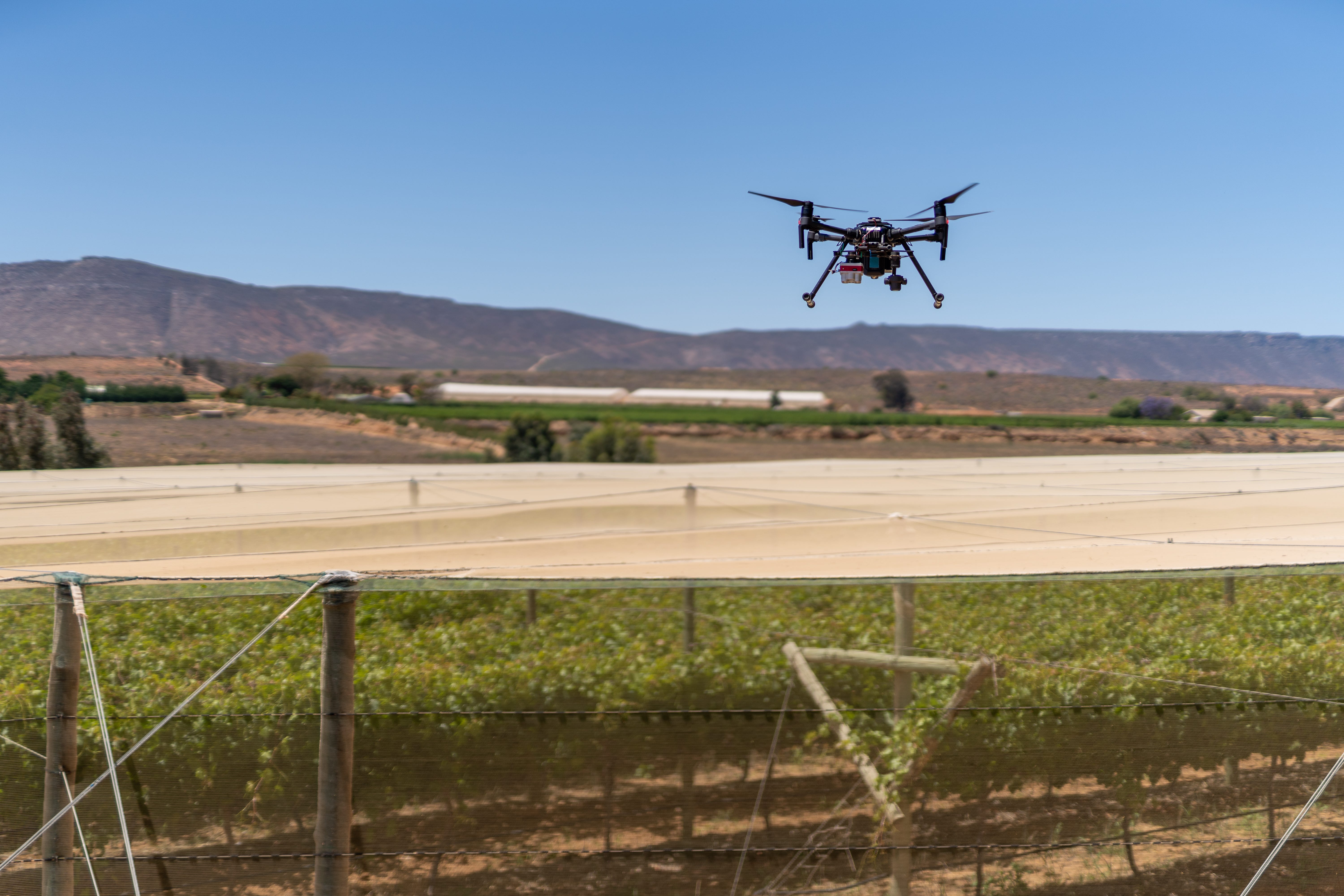
1. Drone mapping under nets: when the net becomes an optical filter
Drone imagery works because it captures the canopy directly.
Under nets, this becomes conditional.
It’s worth knowing what tends to work, what tends not to work, and what you can do to keep the data useful.
In general, lighter nets allow more workable remote sensing. Dense or dark nets usually don’t.
A 20% white net refers to shade percentage. It blocks 20% of incoming sunlight and allows about 80% through to the plants.
That has two knock-on effects for mapping:
Less light reaches the canopy to begin with.
Less reflected light reaches the sensor.
So even when you can produce maps, overall vegetation index values may be subdued, and repeatability becomes the bigger challenge.
Some farms still get workable results under lighter netting, including light colours like light blue. But expectation management matters. Under net, the question is often less “can I map?” and more “can I compare?”
Even under light shade netting, distortions can reduce repeatability.
Common patterns:
Occlusion and pattern interference. The net grid obscures canopy features and introduces repeating structure. Stitching and feature matching can suffer.
Reflectance instability. Nets change the light field through shading, diffusion, and highlights. Indices can become noisier or subdued, especially when conditions differ between flights.
Change detection becomes harder. If each flight is influenced differently by light and net interaction, the difference you see may be artefact rather than crop change.

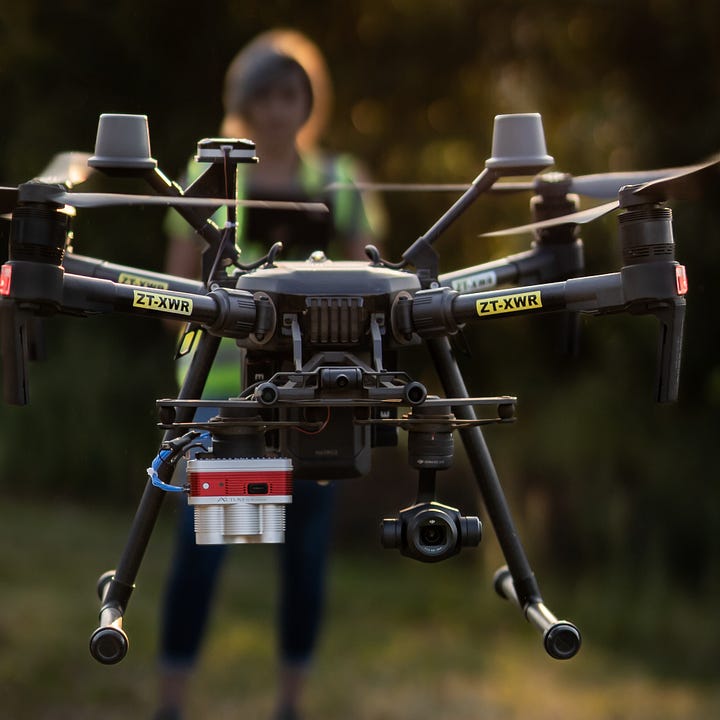

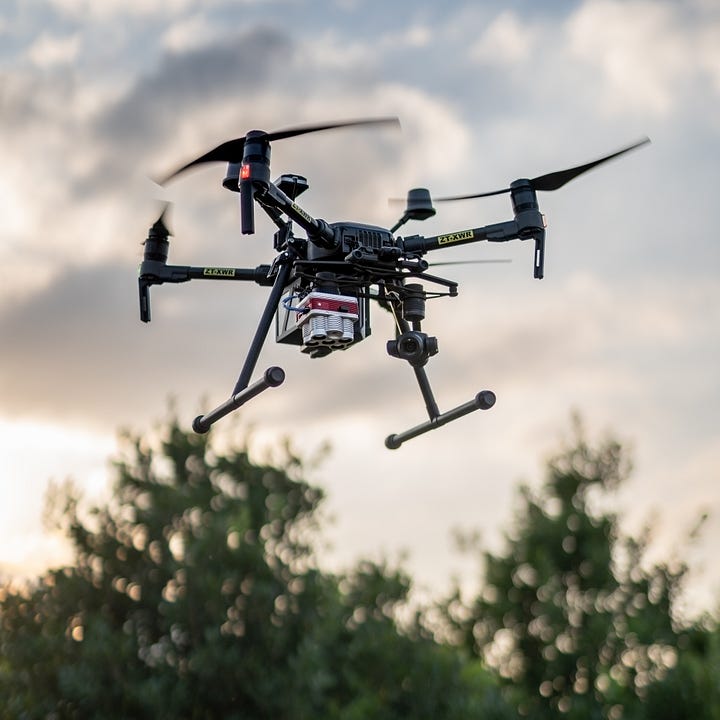
Pilot: Monique Heydenrych (DSI), images by Ken Treloar


Practical fixes that usually work
Separate your analysis universe. Treat netted blocks as their own class. Don’t casually compare them to open blocks.
Split dashboards if you can. If your platform allows it, keep netted and non-netted blocks on separate profiles so the one doesn’t skew the other when benchmarking or ranking.
Standardise capture conditions. Same time window, similar sun conditions, consistent altitude and overlap, consistent phenology stage. Under net, discipline matters more.
Build block-specific baselines. Focus on within-block change detection rather than chasing perfect absolute values.
Validate early. Field-check the first few maps until you understand what “normal” looks like for that net structure.
Under net, you earn trust in your maps through validation. Not through default assumptions.
2. Spray drones and manned aerial application: Nets change the safety envelope and the deposition pattern
Netting can act as a drift barrier.
But it can also make aerial application inconsistent or risky, depending on the design and local operating rules.
Typical constraints show up fast:
Access constraints: Infrastructure can prevent safe passes or make approach corridors too tight.
Collision and snag risk increases: Cables, anchors, sagging spans, and edge hardware become hazards. Mapping is higher altitude. Spraying is close-in.
Airflow behaviour shifts: Rotor wash and deposition patterns change near net structures. Bounce-back and uneven coverage are more likely.


Practical ways to work around it
Plan as if aerial is not your default: Build robust ground application workflows for netted blocks as the baseline. Treat aerial over-net spraying as an exception case.
If aerial is required, treat it as specialised work: Tighter wind limits. Defined flight corridors. Experienced operators only.
Use technology to protect the asset: Geofenced boundaries, hazard point pins, and net-specific pre-flight checklists.
Spraying over nets can still be done, by drones or by manned aircraft. But the net changes the risk profile. The decision needs to be explicit, not assumed.
3. Unmanned ground vehicles: Netted orchards become a “built environment”
Under net, the orchard becomes more engineered.
That has advantages. But it introduces hard edges.
Unmanned ground vehicles (UGVs), autonomous sprayers, robotic mowers, and in-field haulers are suddenly operating in a space with more obstacles, tighter turns, and less room for recovery.
Common issues:
Tight margins. Poles, cables, and anchors reduce forgiveness in headlands and turns. This needs to be accounted for in route planning and safety logic.
Signal behaviour near infrastructure. Depending on equipment and layout, guidance and correction can be less stable near structures.
Workflow friction increases. Moving platforms and implements through structured blocks takes more planning, more training, and stronger rules of movement.
Solutions that reduce headaches
Map infrastructure inside your tools. Treat poles, anchors, and no-go zones as part of the operational map. Not tribal knowledge.
Design headlands intentionally. Under net, turning space is value. Headlands are not wasted area. They are autonomy insurance.
Train for repeatability. Standard routes and right-of-way rules reduce mistakes. Under net, operator habits and contractor discipline matter more.
The pivot farms miss: Nets don’t kill autonomy. They demand better systems thinking
Nets are an investment in resilience, while unmanned vehicles are an investment in efficiency and precision. When you combine them, you don’t automatically get both benefits at full strength. You get a more complex system.
The farms that win are the ones that acknowledge that complexity early. They redesign flight planning, ground routes, headlands, hazard mapping, and data interpretation around the netted reality. Not around the open-orchard memory of how things used to work.
A practical rule of thumb
If your autonomy programme relies on assumptions of open sky and open space, it will struggle under net. However, if your autonomy programme is designed around constraints, it will scale under net.
Ask yourself, “Where has netting reduced my crop risk, but increased my autonomy and workflow risk?”
The thinking starts here, but the real change starts when we take action.
Thanks for reading,
Ken
Grab my latest book over here.