


The setting may have been relaxed, but the message was serious. Let’s dive in!
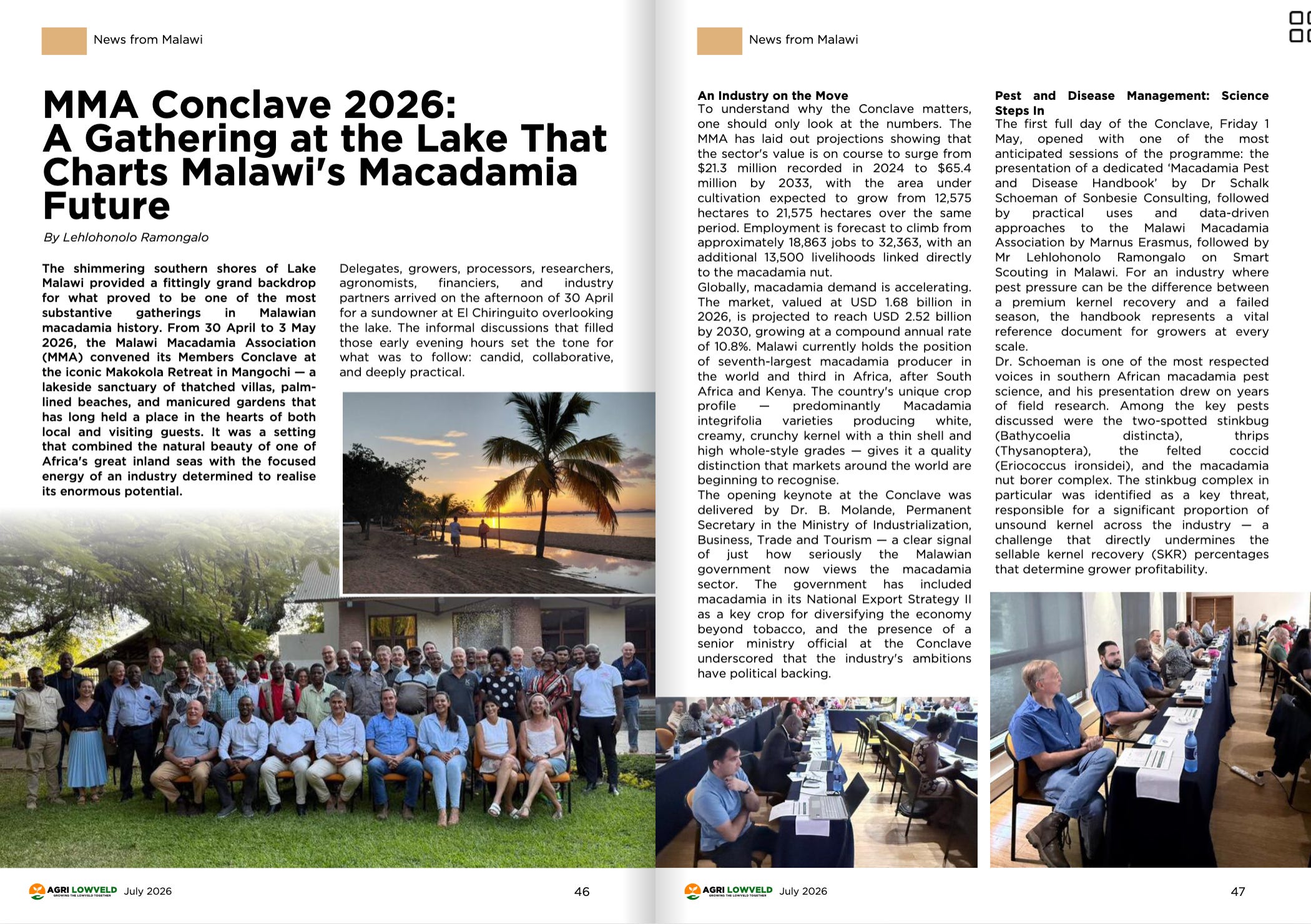
From 30 April to 3 May 2026, members of the Malawi Macadamia Association gathered at the Makokola Retreat on the southern shores of Lake Malawi.
Growers, processors, researchers, agronomists, financiers, crop-input specialists and industry partners came together for the association’s annual Conclave.
The programme extended well beyond conventional conference presentations. It combined market analysis, pest-management science, cultivar research, soil nutrition, pruning discussions and practical demonstrations inside a commercial orchard.
The result was a useful snapshot of an industry entering a more disciplined stage of development. Malawi is no longer discussing macadamias only as a promising alternative crop.
The discussion has shifted towards how the industry will protect quality, improve orchard performance, manage expansion and compete in demanding international markets.
An industry preparing for scale
Projections presented by the Association placed the value of the country’s macadamia sector at approximately US$21.3 million in 2024. This was forecast to rise to US$65.4 million by 2033.
The area under cultivation was expected to increase from approximately 12,575 hectares to 21,575 hectares over the same period. Direct employment was projected to rise from around 18,863 jobs to more than 32,000, with thousands of additional livelihoods connected to processing, transport, services and the wider value chain.
These figures are projections rather than guarantees. Their importance lies in the scale of the ambition they represent.
More trees require more than additional land. Expansion places pressure on nursery quality, cultivar selection, technical capacity, pest control, extension services, processing infrastructure and access to reliable markets.
Malawi’s government has also identified macadamias as part of its export-diversification agenda. The country’s National Export Strategy II includes macadamia nuts among the products targeted for development, alongside other strategic agricultural value chains.
The opportunity is therefore agricultural, commercial and national.
Pest management enters a more precise phase
Pest pressure received substantial attention during the Conclave, reflecting its direct connection to kernel quality and grower returns.
Dr Schalk Schoeman of Sonbesie Consulting presented work towards a dedicated Malawi macadamia pest and disease handbook. The aim is to provide growers with a practical reference based on local pest conditions rather than relying entirely on recommendations developed for other production regions.
Among the major threats discussed was the stinkbug complex. Feeding damage can reduce sound kernel recovery, create internal quality defects and weaken the percentage of a crop that qualifies for premium markets.
This is an important distinction. An orchard can carry a visually acceptable crop while still losing considerable value inside the shell.
The pest-management sessions also covered smart scouting, biological control and the use of parasitoids and predatory organisms.
Koppert presented work involving biological agents for pests including stinkbugs, thrips and macadamia nut borer. Practical demonstrations later took some of this science into the orchard.
The broader lesson was not that biological control will replace every conventional crop-protection product. It was that effective pest management requires an integrated system.
Farmers need to know:
Which pest is present.
Where pressure is increasing.
When economic damage is likely.
Whether an intervention has worked.
How the programme affects beneficial organisms.
This is where structured scouting records, trap data, mapped observations and repeated measurements become valuable. Technology does not remove the need for trained field personnel. It helps those teams inspect more intelligently and build evidence over time.
The move is away from treating the entire orchard as one uniform pest environment.
Nutrition becomes a management system
The Conclave’s nutrition sessions reinforced another fundamental principle: macadamia nutrition cannot be managed effectively through a generic fertiliser programme.
Jeremy Bright led discussions on soil and leaf sampling, nutrient interpretation and cultivar-specific recommendations. The session emphasised that macadamia requirements differ between cultivars and that fertiliser decisions should be supported by accurate diagnostic information.
Leaf analysis provides a measurable indication of a tree’s nutritional status. Soil analysis adds information about the environment in which its roots must function. Neither should be treated as a once-off compliance exercise.
Their value increases when results are collected consistently and compared across:
Blocks.
Cultivars.
Soil types.
Tree ages.
Production seasons.
A single laboratory result records one point in time. A structured sampling history reveals direction.
This distinction matters because a fertiliser programme can be expensive while still failing to correct the underlying limitation. The problem may involve nutrient availability, soil acidity, root health, drainage, irrigation distribution or an interaction between several factors.
Accurate data does not automatically provide the answer. It prevents growers from starting with the wrong question.
Cultivar decisions carry long-term consequences
Cultivar selection was another major subject.
Wayne Hancock presented research on new selections and cultivar trials, highlighting the importance of evidence when making planting decisions. Newer cultivars can offer improved kernel recovery, yield performance and other commercial characteristics, but their suitability must still be evaluated under local conditions.
A macadamia orchard is a long-term capital asset. Cultivar decisions made today will influence production, management requirements and marketability for decades.
Trial data therefore needs to examine more than early tree growth. It should consider:
Yield stability.
Kernel recovery.
Nut quality.
Pest sensitivity.
Harvest timing.
Local climate performance.
The wrong cultivar in the wrong environment is not easily corrected. By the time the limitation becomes commercially obvious, the grower may already have invested years of land, labour, water and capital.
China, quality and market diversification
Commercial discussions at the Conclave also looked towards China and the wider international market.
China has become a major force in global macadamia trade, particularly for nut-in-shell products. As one regional example, the value of South African in-shell macadamia exports to China increased from approximately US$35 million in 2020 to US$127 million in 2024.
For Malawi, greater access to China and other Asian markets presents an opportunity to diversify beyond a narrow group of buyers.
It also introduces stricter commercial requirements.
Market access must be supported by:
Reliable supply.
Consistent quality.
Product standards.
Strong traceability.
Credible phytosanitary systems.
Export diversification reduces dependence on any single destination. It does not remove the need to understand what each market wants.
The strongest position is not achieved by producing the greatest possible volume and then looking for somewhere to sell it. It comes from aligning orchard production, processing standards and market demand before the crop reaches maturity.
Pruning is a commercial decision
Pruning was described as a non-negotiable macadamia management practice.
Riaan de Villiers led a session on orchard pruning and hygiene, followed by an interactive discussion in which growers compared their own experiences.
The central message? Pruning is not a cosmetic exercise.
As trees mature, unmanaged canopies become dense. Light penetration declines, productive bearing wood becomes less efficient, spray coverage deteriorates and conditions become more favourable for certain pests and diseases.
One case study presented at the event recorded a decline from approximately nine tonnes per hectare in the eighth year, to three tonnes per hectare in the ninth year in an unpruned orchard.
While performance differs between orchards, the example illustrates the financial exposure associated with delaying structural management.
Pruning opens the canopy to light, encourages renewal of bearing wood and improves the effectiveness of crop-protection applications. It should therefore be viewed as yield infrastructure.
The cost of pruning is visible immediately. The cost of not pruning often appears later, after the canopy has become difficult and expensive to correct.
Taking the discussion into the orchard
The final day moved from the conference venue to Agrivest’s Chitakale Estate near Namwera in the Mangochi District.
Established in 2020 through the conversion of former tobacco estates, the commercial operation includes more than 600 hectares of macadamias under both rain-fed and irrigated production.
Delegates took part in practical soil-sampling demonstrations, pruning discussions and biological-control activities. The visit transformed the preceding presentations into visible field applications.
This transition from boardroom to orchard was important.
A recommendation that sounds straightforward during a presentation can become considerably more complex when applied across hundreds of hectares, varying soils, different tree ages and multiple cultivars.
Field demonstrations expose those practical details. They also allow growers to compare methods, challenge assumptions and learn from results achieved under commercial conditions.
Markets, money and collective capacity
The Conclave also included updates from the MMA Executive Committee and sessions involving financial and market organisations.
Discussions covered governance, market intelligence, pricing pressure, access to finance and the importance of maintaining quality in volatile trading conditions.
These subjects are sometimes separated from orchard management. In practice, they are closely connected.
A grower’s ability to invest in irrigation, pruning, replanting, pest control and nutrition depends on financial confidence. That confidence depends on production forecasts, market access, price expectations and the ability to demonstrate that the orchard is being managed as a productive asset.
The association therefore has a role beyond organising an annual gathering.
It can coordinate technical knowledge, represent growers, support common quality standards, engage with government and help the industry communicate with markets using a more unified voice.
For newer and smaller growers, this shared capacity is especially important. Established estates can employ specialists and build their own networks. Emerging growers often depend on associations to provide access to research, trusted advisers and practical examples.
What the Malawi Conclave tells the wider orchard sector
Pest management affects kernel quality.
Nutrition influences canopy performance.
Cultivar choice shapes future production.
Pruning affects light, yield and spray efficacy.
Market standards determine which part of the crop earns a premium.
Finance affects whether corrective work can be completed at the right time.
These are not isolated management categories.
They form one orchard system.
The most important outcome of the Conclave was not a single presentation, biological product, cultivar or market opportunity. It was the convergence of these subjects.
The same principle applies to agricultural technology. A drone map, scouting application, lab report or digital dashboard has limited value when treated as a standalone product.
Its real value appears when the information changes a decision:
Where should the team inspect?
Which trees or zones should be sampled?
Which intervention should receive priority?
Did the treatment produce a measurable improvement?
Which orchard practices are protecting future yield and quality?
We cannot focus solely on collecting more data. It’s more important to use available data to reduce uncertainty around actions that carry commercial consequences.
Building Malawi’s macadamia future
Malawi already holds an important position within African macadamia production. Its next stage of development will depend on more than planting additional hectares.
The sector must convert expansion into consistent, marketable production.
That requires better pest intelligence, credible sampling systems, suitable cultivars, disciplined canopy management, reliable processing, common standards and access to diversified markets.
The MMA Conclave 2026 showed an industry engaging openly with these requirements. It also demonstrated the value of bringing science, commercial decision-making and orchard practice into the same conversation.
The lake provided the backdrop, while the orchard provided the direction.
Editorial note: This AgTech Diaries article is adapted and expanded from “MMA Conclave 2026: A Gathering at the Lake That Charts Malawi’s Macadamia Future,” written by Lehlohonolo Ramongalo and published in the July 2026 edition of Agri Lowveld. The original report appears on printed pages 46–51. This version reorganises the event coverage around the practical orchard-management and industry lessons that emerged from the Conclave.
You can also find Agri Lowveld on Facebook