

Every January, I try and do one thing before I start chasing the next big idea:
I look back.
Here’s a quick take on my rearview mirror viewpoint;
as we embark on the adventure that 2026 has to promise.
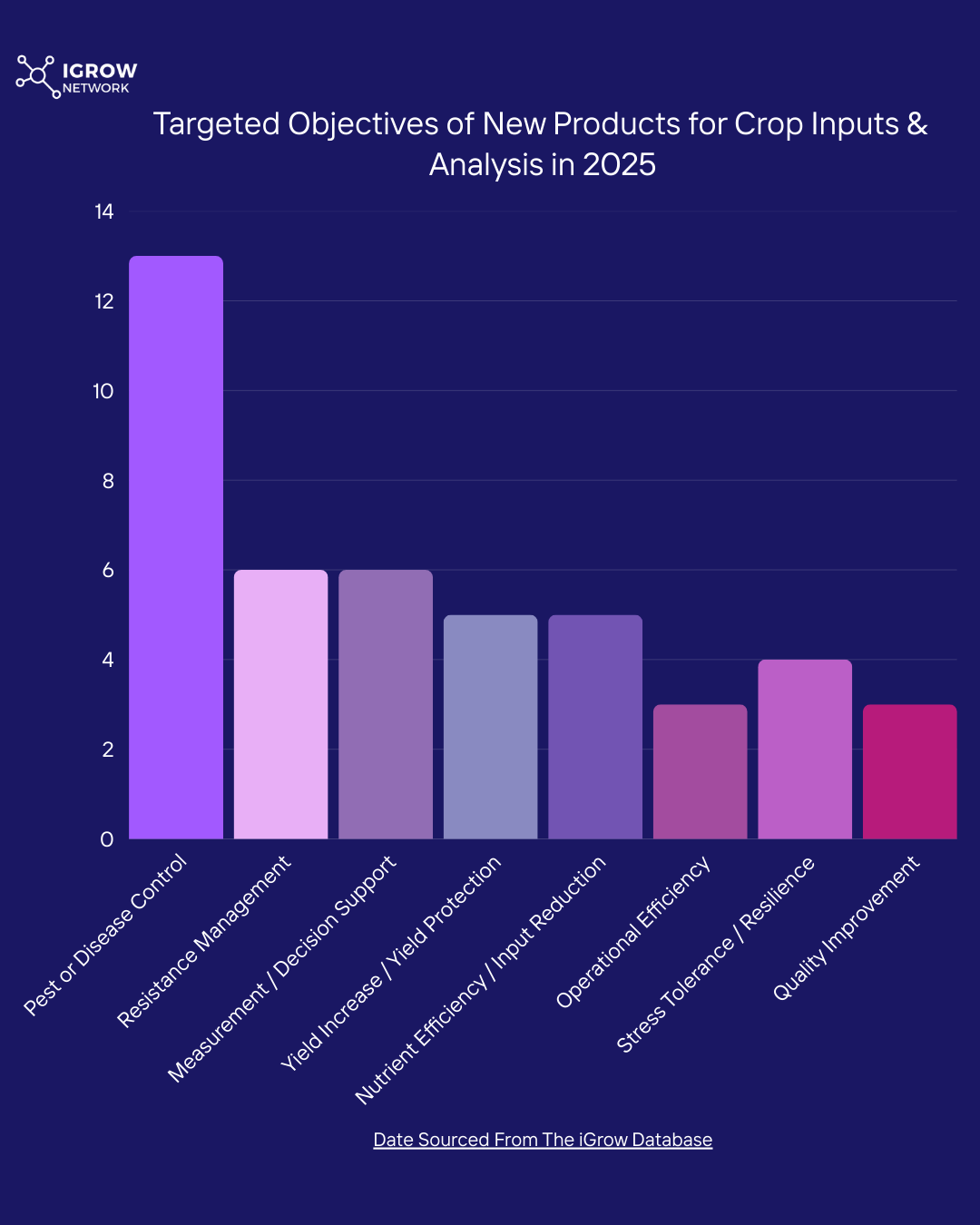
Avoiding marketing headlines, and shiny launch presentations, I decided to take a look at the patterns underneath all the noise from the past year.
The agricultural inputs landscape in 2025 offers us a clear view into how companies were - and are - allocating innovation focus.
Product launches are rarely a simply offering of the “new products” out right now. They’re a snapshot of what the industry believes is worth building when pressure is rising from every angle. Biology, regulation, margins, mode-of-action resistance, climate issues, labour, logistics… the list goes on.
In particular, if you watched the agricultural inputs space in 2025, the pattern was surprisingly clear: No grand revolution in chemistry (the biggest innovation story in 2025 wasn’t new actives; it was better deployment, durability, and risk control).
No sudden pivot into entirely new agronomic realms. But an increasingly conservative, pragmatic kind of innovation (no mass move into “new farming systems”; the momentum was in optimisation layers, not paradigm shifts).
2025 wasn’t a wholesale rewrite of how farms are run. No broad reset of agronomy. No widespread shift to radically new production systems, or a leap into a brand-new way of farming.
Most of the progress in 2025 showed up as incremental upgrades that sharpened existing playbooks: measurement, targeting, compliance, and resilience. A focus on optimisation of existing tools; extending durability; managing risk for farmers operating in tighter and tighter constraints.
Here’s what I mean:
Downside protection eclipsed upside expansion
Across the launches announced in 2025, product positioning was heavily skewed toward protection rather than expansion.
Pest and disease control dominated primary claims. Resistance management showed up frequently. Measurement and decision-support tools featured strongly as enabling layers.
Interestingly, claims that centred on direct yield uplift, or transformational performance leaps, were comparatively rare.
That does not mean companies stopped caring about yield. It means they stopped leading with pledges of XYZ increases and empty promises. Rather, yield forecasting, monitoring, quality evaluations, and utilisation of in-field data for precise and proactive market planning, was the name of the game in 2025.
When any system is under stress, the first priority usually becomes one of maintaining system function. Keeping production stable. Preventing losses. Stretching the effectiveness of what already works. Avoiding regulatory surprises. Slowing resistance. And reducing the risk of a poor season slipping into becoming a catastrophic one.
The quiet shift: “better deployment” = the new innovation frontier
One of the more important signals from 2025 is that measurement, nutrient efficiency, and decision-support tools are increasingly being built as system enablers. Not as replacements for crop protection, fertiliser, or genetics. But as multipliers. And I believe we will likely see more of this in 2026.
Tools that help farmers deploy existing inputs more precisely, more defensibly, and with less waste. Tools that support timing, targeting, and documentation. Tools that make “doing the right thing” operationally easier in a messy, real-world scenario: farming when under pressure, stress, and the weight of maintaining system function.
In other words, right now the innovation focus is moving upstream into decision quality. Because if you can improve on decisions, you can improve on outcomes, in many cases without changing the input.
That is a big deal for perennial crops in particular; the cost of a wrong decision lingers for seasons, not weeks. The positive spin-off on a sound decision? Golden.
Why this makes sense right now
If you work in orchards, vineyards, or perennial systems, this trend probably feels familiar. You can have a great chemistry. A great biological. A great nutrition product. But if the timing is off, or the canopy is uneven, or the irrigation is inconsistent, or the disease pressure is patchy, performance becomes unpredictable. Management rough.
And unpredictable performance is where confidence goes to die.
2025 looked like an industry responding to that reality.
Not by promising miracles. But by building buffers. By improving consistency. By investing in tools that manage variability rather than pretending it does not exist.
What farmers should take from this:
If you are a farmer, this is your reminder that the “next product” is not always the answer. The bigger advantage may come from tightening the system you already have:
Improved monitoring before you intervene
Better targeting when you apply
Well kept records so you can learn what actually worked
More awareness of resistance and regulatory trajectories
Better integration between what you see in-field and what you decide in the office
This is also where the practical value of decision-support becomes real. Not as dashboards for the sake of dashboards; but as tools that reduce uncertainty and speed up action when timing matters.
What product teams should take from this:
If you build products for agriculture, 2025 reads like a market signal that everyone from small-scale farmers, family business, and global agricultural enterprises are willing to pay for risk reduction.
They want reliability. They want durability. They want tools that fit constrained operations, conditions, budgets, and capacity. Tools which work under pressure.
And you know what?
They are signalling something else.
They do not need more complexity.
They need more leverage.
If a new tool requires a complete behavioural overhaul, a new data workflow, and another login, it will struggle - unless the value is unmistakable and immediate.
The winning products will be the ones that slot into existing agronomic reality, and then quietly improve it.
It’s one of the reasons I’m unapologetically an Aerobotics fan - they’re doing this really well.
Innovation is not always a new chemistry. Sometimes it’s simply a better decision, made earlier, and with less guesswork.
Where I’m going with this in 2026…
January for me has become more about mulling things over and planning, compared to jumping right in with all guns blazing. As such, this early-Feb post is the starting point for my AgTech musings going into 2026.
Next, I want to unpack what these trends look like on the ground for perennial crops; citrus, macadamias, avocados, vines, etc. I plan to connect the dots to how remote sensing, field scouting, and decision-support actually change the way inputs are used.
For now though… consider this reflection as we kick 2026 into high gear: “If the industry is still building for downside protection and system stability, what should we actually be prioritising on-farm?”
The thinking starts here, but the real change starts when we take action.
Wishing you all the best wherever you are.
Best regards,
Ken
Find my latest book over here:
https://linktr.ee/KenTreloarDroneBook